I've had my digital camera for exactly one month today. The weather for January was a little too cold for my favorite photography, landscapes, but I did manage to get a few test shots. The rest I shot in the house with supplementary lighting and natural window light.
The camera is a Fuji S602Z. The camera's CCD is touted at capturing 6mp (mega pixels) due to interpolation, but independent testing has shown the camera to capture 4.3 true mp. At any rate, it's plenty for 11x14 inch enlargements and that my dear readers, is plenty for my needs. The camera has full auto as well as full manual controls and has manual and auto focusing capabilities. It has eight white balance modes including two user-defined modes. Three modes of auto sharpening are available in camera, although the difference between normal and sharp is not enough to help. I prefer to shoot in soft and do all my sharpening in Photoshop's USM (unsharp mask). This enables me to get the maximum amount of sharpening I need for pinpoint accuracy.
The self-timer may be used at two or ten seconds. Two seconds is great when you would normally use a cable release for times exposures. The tripod socket is metal and I installed a quick release shoe permanently to the camera for ease of operation. It also has five burst modes, great for capturing action shots and a preview window to see what you have before recording it to the flash card. The sixteen mp flash card that comes with it is useless and I bought a 128mp card. The use of rechargeable batteries is recommended and a spare set is also quite useful. The built in flash is small as you would expect but you are able to add power by as much as two stops directly in the camera. An added bonus is that it accepts other flash units that may be used via the hot shoe.
The lens is a 35 to 210mm zoom and the use of telephoto or wide-angle attachments is possible. Two modes of macro focusing, the first lets you focus from ten to twenty centimeters from the subject and the second from one centimeter away. I have found the last mode useless because when the lens is that close to an object, it eliminates a lot of the lighting and causes deep shadows and loss of detail. There are still many little adjustments possible, but for this review, I'll stick to the most common.
|
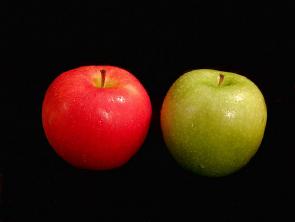
This picture was shot indoors with a 250-watt halogen flood just above and at a forty-five degree angle. A second light, a 75-watt spot, was aimed from above and I used a silver reflector on the left to eliminate shadows. The reds and greens are true and the black of the background is deep and rich.
|
|
|---|
|
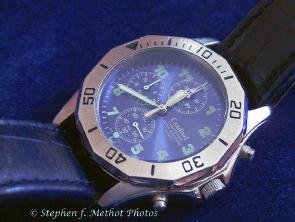
The photo of the watch was shot using natural window lighting and the blues are an accurate reproduction of the scene.
|
|---|
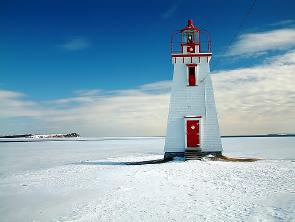
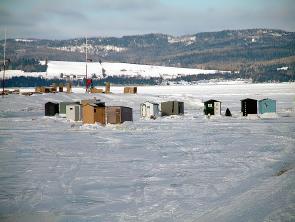
Next, I did manage to get a few outdoor shots. The first is the Inch Arran lighthouse. This was shot at noon and required the use of a polarizer to get the sky properly exposed and finally a shot of the 'Shanty Village'. All the images are true in color reproduction. Exposure mode was manual and seemed to work flawlessly. The white balance chosen for outdoors was automatic, indoors I used the tungsten mode, and the two-second self-timer with the camera mounted on a tripod.
The camera is equipped with an auto bracketing mode and multi-exposure capability. I have not yet tried out these functions, but will in the very near future.
I did make prints from the files on my Cannon printer and they were superb. The colors were stunning as was the detail and my next purchase will be a Cannon i900 that will enable me to make super 11x14 inch prints from the six mp files that this camera is capable of producing.
To summarize, first, the ergonomics are very good and the camera fits my hand like a glove. It is much like a regular thirty-five mm and operates in a similar fashion. The auto focus is reliable and very quiet. The exposure modes are spot on and produces consistently well exposed photographs Second, the preview function is something that once used, is hard to do without. Third, the macro capability of this unit is quite remarkable and gives superb results. The zoom is sufficient and with the telephoto adaptor is plenty for every day use.
Things I don't like, first, very hard to focus in darker conditions, mainly night shots. Second, I wish there was a cable release instead of having to use a self-timer. There is a distinct lag after focusing, but before taking the shot. It has a huge appetite for batteries and the only way to get around this is to use rechargeables though, to be fair, this is common to all digital cameras and not just Fuji. Finally, the LCD screen is small and hard to use in bright conditions. I find myself using the EVF (electronic viewfinder) increasingly, as I do not have to be constantly putting on my glasses when previewing pictures.
To be honest, I appreciate this new technology and seeing the picture immediately is a big thing. Once purchased the costs for pictures drop dramatically and failed shots is a thing of the past. I can see the day approaching, rather quickly too I might add, when digital will be all the photography that I'll be doing.